


: Intelligent Recovery: Automated Failover, Monitoring, and Disaster Recovery Orchestration for Business Continuity
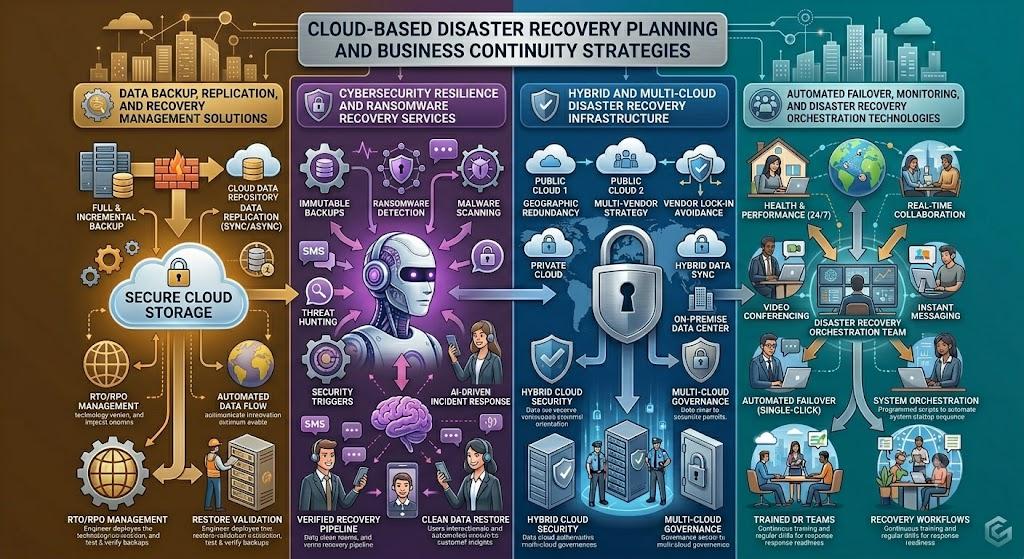
The speed and reliability of disaster recovery depend on automation and intelligence. Automated Failover, Monitoring, and Disaster Recovery Orchestration Technologies enable organizations to execute recovery procedures rapidly and consistently, reducing downtime and minimizing business impact. These technologies automate the complex, error-prone processes of failover and recovery, ensuring that systems are restored in the correct order and within defined timeframes.
Automation and orchestration are most effective when integrated with comprehensive planning. Cloud-Based Disaster Recovery Planning and Business Continuity Strategies provide the framework for defining recovery requirements, procedures, and governance. The combination of intelligent automation and strategic planning creates a robust recovery capability that ensures business continuity.
Understanding Automated Failover
Automated Failover, Monitoring, and Disaster Recovery Orchestration Technologies include capabilities for automating the failover process. Automated failover detects failures and triggers recovery procedures without manual intervention. This reduces recovery time and eliminates the risk of human error during stressful recovery scenarios.
Automated failover includes health monitoring that detects failures; decision logic that determines when to trigger failover; and execution that performs failover procedures. For effective automated failover, organizations must define clear failover criteria and thoroughly test failover procedures.
The Role of Monitoring in Disaster Recovery
Monitoring is essential for effective disaster recovery. Automated Failover, Monitoring, and Disaster Recovery Orchestration Technologies include monitoring capabilities that provide visibility into system health, replication status, and recovery readiness. Monitoring enables organizations to identify issues before they become critical and to track recovery progress during incidents.
Key monitoring capabilities include infrastructure monitoring, which tracks the health of servers and networks; application monitoring, which tracks application performance and availability; and replication monitoring, which tracks the status of data replication. Monitoring also includes alerting that notifies teams of issues and dashboards that provide visibility into recovery status.
Benefits of Automated Orchestration
Organizations that implement Automated Failover, Monitoring, and Disaster Recovery Orchestration Technologies with Cloud-Based Disaster Recovery Planning and Business Continuity Strategies achieve significant benefits. First, they achieve reduced recovery times through automated failover that eliminates manual steps. Top-tier providers now guarantee recovery time objectives between 15 minutes and four hours.
Second, organizations achieve improved reliability through consistent, repeatable recovery procedures. Third, they achieve reduced risk of human error during stressful recovery scenarios. Fourth, organizations achieve improved compliance through documented, tested recovery procedures. Fifth, they achieve cost efficiency through optimized resource utilization.
Key Orchestration Capabilities
Automated Failover, Monitoring, and Disaster Recovery Orchestration Technologies include several key capabilities that enhance recovery operations. Runbook automation executes recovery procedures consistently. Dependency management ensures systems are recovered in the correct order. Parallel execution recovers multiple systems simultaneously.
Validation ensures recovered systems are functioning correctly. Rollback enables recovery to previous states if issues are identified. Reporting provides documentation of recovery activities. These capabilities work together to create reliable, efficient recovery operations.
Integration of Automation and Planning
The integration of Automated Failover, Monitoring, and Disaster Recovery Orchestration Technologies with Cloud-Based Disaster Recovery Planning and Business Continuity Strategies requires a unified approach. Planning defines the recovery requirements, procedures, and governance that automation executes. Automation provides the execution capabilities that implement the plan.
This integration requires that recovery procedures are documented in a format that automation can execute. Organizations should develop recovery runbooks that define the steps for recovery and the conditions for triggering failover. Additionally, organizations should test automation regularly to ensure it works as expected.
Best Practices for Automated Recovery
To implement effective Automated Failover, Monitoring, and Disaster Recovery Orchestration Technologies with Cloud-Based Disaster Recovery Planning and Business Continuity Strategies, organizations should adopt several best practices. First, they should define clear recovery time objectives and recovery point objectives for each workload. Second, they should document recovery procedures in a format that automation can execute.
Third, organizations should test automation regularly using non-disruptive testing. Fourth, they should monitor recovery infrastructure continuously to identify issues. Fifth, organizations should maintain documentation of recovery capabilities and procedures.
Future of Recovery Automation
The future of Automated Failover, Monitoring, and Disaster Recovery Orchestration Technologies and Cloud-Based Disaster Recovery Planning and Business Continuity Strategies is shaped by several emerging trends. The adoption of AI is enabling intelligent orchestration and predictive failover. AI-powered systems can detect anomalies, trigger failover, and validate recovery without human intervention.
The emergence of recovery-as-code is enabling version-controlled, testable recovery runbooks integrated with CI/CD pipelines. The integration of threat intelligence is enabling proactive failover in response to detected threats. Additionally, the development of autonomous recovery is enabling self-healing systems.
Organizations that invest in Automated Failover, Monitoring, and Disaster Recovery Orchestration Technologies and Cloud-Based Disaster Recovery Planning and Business Continuity Strategies will be well-positioned to achieve rapid, reliable recovery. Cloud-Based Disaster Recovery Planning and Business Continuity Strategies provides the framework for defining recovery requirements and procedures, while automation ensures that recovery is executed reliably and efficiently.

 Arabic
 French
 Spanish
 Portuguese
 Deutsch
 Turkish
 Dutch
 Italiano
 Russian
 Romaian
 Portuguese (Brazil)
 Greek
