


Shedding Pounds, Gaining Grip: How Lightweight Suspension Components Are Transforming Vehicle Dynamics
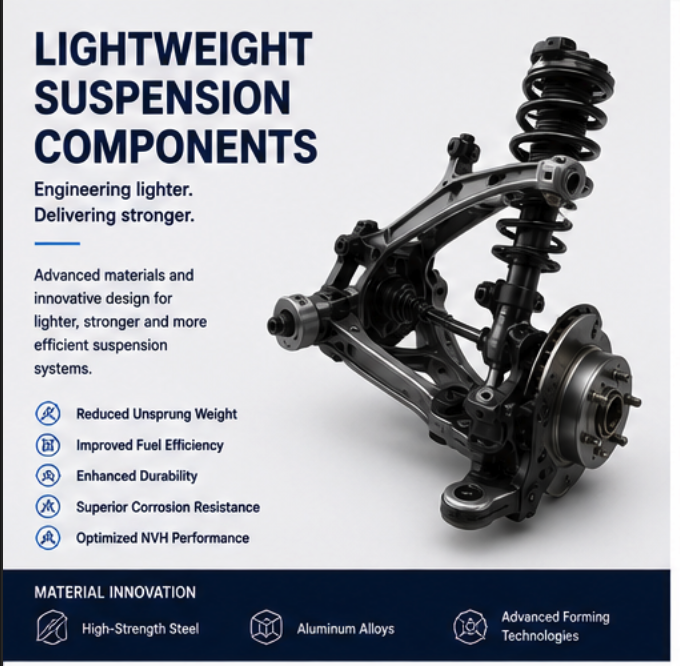
Every pound saved in a vehicle's suspension system pays dividends twice over—first in fuel economy, and again in handling responsiveness. Lightweight Suspension Components have become a focal point for automakers seeking to meet stringent emissions regulations while delivering the crisp handling that modern drivers expect. Among the most impactful of these components is the anti-roll bar, which controls body lean during cornering. Vehicle Anti-Roll Bar Systems have evolved significantly, with hollow designs replacing solid bars to achieve dramatic weight savings without sacrificing stiffness.
The Weight Penalty of Suspension
Why does suspension weight matter so much? The answer lies in "unsprung mass"—the components not supported by the vehicle's springs, including wheels, tires, brakes, and suspension links. Lower unsprung mass allows the suspension to respond more quickly to road irregularities, keeping tires in better contact with the pavement.
For every kilogram saved in unsprung mass, the effective handling improvement is roughly equivalent to saving 4-5 kilograms of sprung mass (the vehicle body). This is because unsprung components move independently of the body; reducing their inertia allows them to react faster to bumps and undulations.
Lightweight Suspension Components address this directly. A hollow stabilizer bar can weigh 30-50% less than a solid bar of equivalent torsional stiffness. This weight reduction is "free"—it does not compromise structural integrity or performance.
The Stabilizer Bar: An Unsung Hero
Before diving into lightweighting techniques, it is worth understanding what a stabilizer bar (also called an anti-roll bar or sway bar) does. It is a U-shaped steel bar that connects the left and right wheels of an axle. When the vehicle corners, body weight transfers to the outside wheel, compressing that side's suspension. The stabilizer bar twists, transferring some of that force to the inside wheel, effectively "pulling" it up and reducing body roll.
Vehicle Anti-Roll Bar Systems are critical for:
-
Reducing body lean: Keeps the vehicle flat in corners, improving driver confidence.
-
Enhancing tire contact: Maintains optimal tire patch alignment with the road.
-
Improving transient response: The vehicle changes direction more quickly.
-
Balancing handling: Allows tuning of understeer/oversteer characteristics.
A stiffer bar reduces roll more but may degrade ride quality over single-wheel bumps. Engineers carefully tune bar stiffness to balance cornering grip and ride comfort.
From Solid to Hollow: The Lightweighting Breakthrough
Traditional stabilizer bars are solid steel rods. They are heavy but simple to manufacture. The breakthrough came with the realization that for a given torsional stiffness, a hollow bar can be significantly lighter.
The torsional stiffness of a bar is proportional to the fourth power of its diameter (for a solid bar) but also depends on wall thickness for hollow bars. This means a hollow bar with a larger diameter and relatively thin wall can achieve the same stiffness as a smaller-diameter solid bar, while weighing much less.
Consider this comparison for a typical front stabilizer bar:
| Parameter | Solid Bar | Hollow Bar | Change |
|---|---|---|---|
| Diameter | 22 mm | 26 mm | +18% |
| Wall thickness | N/A | 4 mm | N/A |
| Torsional stiffness | 100% | 100% | Same |
| Weight | 4.5 kg | 2.8 kg | -38% |
The hollow bar uses 38% less material while performing identically. This weight saving comes from removing metal from the bar's center, where stresses are lowest.
Manufacturing Hollow Stabilizer Bars
Producing Lightweight Suspension Components like hollow bars requires specialized manufacturing processes:
Extrusion (Seamless Tube):
A solid billet of steel or aluminum is forced through a die to create a seamless hollow tube. This tube is then bent into the U-shape and heat-treated. Extruded bars have excellent uniformity and strength but are more expensive.
Welded Tube:
A flat strip of steel is roll-formed into a tube and welded along the seam. The welded tube is then bent and heat-treated. Welded bars are less expensive but may have strength variations at the weld.
Hydroforming:
A tube is placed in a die and filled with water at extremely high pressure, forcing the tube to conform to the die shape. Hydroforming allows complex cross-sections (not just circular) but requires expensive tooling.
Materials Beyond Steel
While steel dominates the Vehicle Anti-Roll Bar Systems market, alternative materials are gaining traction:
Aluminum (Fastest-Growing):
Aluminum has one-third the density of steel. A hollow aluminum bar can be 50-60% lighter than a solid steel bar of equivalent stiffness. However, aluminum has lower fatigue strength, so bars must be larger in diameter. Aluminum is increasingly used in performance and luxury vehicles.
Carbon Fiber Composite (Emerging):
Carbon fiber offers incredible stiffness-to-weight ratios—up to 5 times higher than steel. A carbon fiber stabilizer bar can be 70-80% lighter than steel. However, carbon fiber is expensive (10-20x steel) and requires complex manufacturing. Currently limited to hypercars and racing.
The Impact on Fuel Economy
Weight reduction directly improves fuel economy. The EPA estimates that reducing vehicle weight by 10% improves fuel economy by 6-8%. For a typical passenger car, every 45 kg (100 lbs) saved reduces fuel consumption by approximately 2%.
Lightweight Suspension Components contribute to this total. A complete suspension system (control arms, stabilizer bars, knuckles, springs) might weigh 80-100 kg. Lightweighting can reduce this by 20-30 kg—enough to improve fuel economy by 0.5-1%.
For electric vehicles, weight reduction directly extends range. An EV with lightweight suspension components may travel 5-15 km further per charge, a meaningful advantage.
Challenges and Trade-offs
Despite their advantages, lightweight stabilizer bars face challenges:
-
Cost: Hollow bars are 20-40% more expensive than solid bars due to complex manufacturing.
-
Diameter constraints: Hollow bars require larger diameters, which may cause packaging issues (interference with other components).
-
Fatigue: Thin-walled bars are more susceptible to fatigue cracking if surface imperfections exist.
-
NVH: Hollow bars may transmit more high-frequency vibration (they have less internal damping).
Manufacturers address these challenges with:
-
Shot peening: Bombarding the bar surface with small beads induces compressive stresses, improving fatigue life.
-
Corrosion protection: E-coating or powder coating prevents pitting that could initiate cracks.
-
Rubber bushings: Isolate the bar from the chassis, reducing NVH transmission.
The Future of Lightweight Suspension
The trend toward lightweight suspension components will accelerate. Key developments include:
-
Multi-material designs: Steel arms with aluminum knuckles, carbon fiber stabilizer bars.
-
Additive manufacturing (3D printing): Enables topology-optimized shapes impossible with traditional methods.
-
Active systems: Electronically controlled stabilizer bars that can disconnect for ride comfort and reconnect for handling.
Conclusion
Every corner your car takes, the stabilizer bar is working—twisting, transferring force, keeping the body flat. Modern Lightweight Suspension Components allow this work to be done with less material, less weight, and less fuel consumption. Vehicle Anti-Roll Bar Systems have evolved from heavy solid rods to sophisticated hollow designs, and the trend toward even lighter, stronger materials continues. The result is vehicles that handle better, consume less fuel, and deliver a more engaging driving experience.

 English
 Arabic
 French
 Spanish
 Portuguese
 Deutsch
 Turkish
 Dutch
Dutch
 Italiano
 Romaian
 Portuguese (Brazil)
 Greek
Greek
