


A Beginner’s Guide to Quadrifilar Helix Antenna
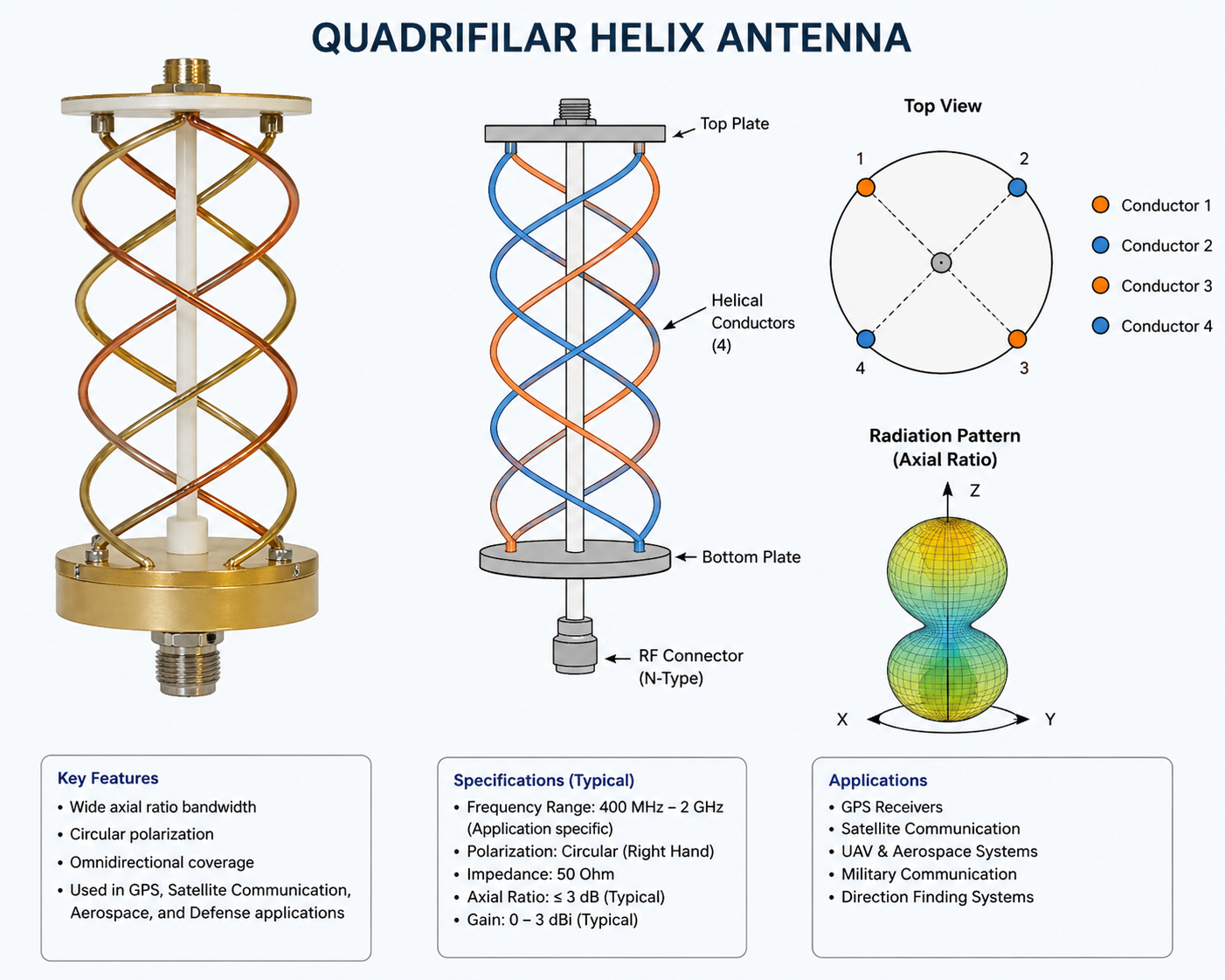
Helix antennas are some of the most popular antennas used in wireless communication systems due to their simplicity and effectiveness. The Quadrifilar Helix Antenna (QHA) is one of the most commonly used types of helix antennas for GPS, satellite and space applications.
For novices, the Quadrifilar Helix Antenna may seem complicated, but its operation is quite simple. In this article, we will discuss what a QHA is, how it operates, its applications and the importance of selecting the right antenna manufacturer to achieve optimal RF performance.
What is a Quadrifilar Helix Antenna?
A Quadrifilar Helix Antenna is a variant of a helix antenna, which is constructed using four spiral (helix) conductors around a central axis. The word quadrifilar means "four wires".
This is in contrast to a simple helix antenna that has a single spiral wire but a Quadrifilar Helix Antenna has four arms which cooperate to produce circular polarization, which makes it ideal for satellite applications.
In simple words:
-
Helix Antenna → single spiral wire
-
Quadrifilar Helix Antenna → four spirals for better reception
Why do you need a Quadrifilar Helix Antenna?
QHAs are primarily used where signals are coming from multiple directions. This is often the case with satellite communications as the satellites are in constant motion.
A QHA is able to receive signals from the sky without regular readjustment. This is the reason why it is widely used as a GPS antenna and satellite communication antenna.
What is the Working Principle of a Quadrifilar Helix Antenna?
A Quadrifilar Helix Antenna works by phase shifting and circular polarization.
Here's the basic concept easy to understand:
-
There are four spiral arms.
-
RF power is applied to the arms with a phase shift.
-
The phase differences result in a rotating field.
-
This results in a circularly polarized signal.
-
Because many satellite signals may be circularly polarized, the Quadrifilar Helix Antenna can receive them with high efficiency and low loss.
Features of a Quadrifilar Helix Antenna
A Quadrifilar Helix Antenna is preferred because of its advanced performance features:
1. Circular Polarization (RHCP / LHCP)
QHAs are typically designed as RHCP (Right-Hand Circular Polarized) antennas, particularly for GPS and satellite applications. Circular polarization helps to eliminate fading
2. Wide Sky Coverage
The radiation pattern of a Quadrifilar Helix Antenna enables it to receive signals from a large area of the sky, making it suitable for satellite tracking.
3. Compact Design
QHAs can be designed in small sizes, despite the four arms, for handhelds, GPS trackers, and embedded systems.
4. Good Performance in Mobile Systems
This helix antenna design is suitable for moving systems such as cars, boats, drones and planes.
Applications of Quadrifilar Helix Antenna
Quadrifilar Helix Antennas are used in industries where stable satellite reception is required.
Common applications include:
-
GPS navigation systems
-
Satellite communication terminals
-
Weather satellite receivers
-
Spacecraft communication
-
Aviation and marine communication
-
Military tracking and defense systems
-
Telemetry and remote monitoring systems
-
A commercial antenna manufacturer may design QHA antennas for specific frequencies such as GPS L1, L2 or satellite frequencies.
Choosing the Right Antenna Manufacturer for QHA
-
Given the design requirements of a Quadrifilar Helix Antenna, working with a professional antenna manufacturer is crucial to achieving optimal performance.
-
A professional antenna manufacturer ensures:
-
Accurate Symmetry and Winding
-
Four helical arms have to be identically shaped and properly placed. Minor discrepancies can impact gain and purity.
-
High-Quality Materials
-
Using copper, RF-safe plastics and protective finishes increase robustness.
-
Correct Phase Feeding
The four arms have to be in-phase. This enables the Quadrifilar Helix Antenna to be circularly polarized.
-
RF Testing and Quality Control
-
A reputable antenna company inspects each antenna for:
-
VSWR
-
Return Loss
-
Gain
-
Radiation Pattern
-
Polarization purity
-
The helix antenna's performance will be disappointing if it isn't tested first.
Before you purchase Test These Specifications
Before choosing a Quadrifilar Helix Antenna, be sure to check these key specifications:
1. Frequency Range
Make sure that the antenna is designed for the right frequencies (GPS L1, satellite band, etc).
2. VSWR (Return Loss)
The smaller the VSWR, the greater the match.
3. Return Loss
Return loss is the amount of signal reflected. The greater the return loss (negative dB), the better.
4. Gain
This affects how strong the radio signal is. QHAs offer gain but it is low.
5. Polarization Type
GPS antennas typically use RHCP with some exceptions for LHCP.
6. Connector Type
SMA, N-Type or TNC are popular but other connectors are possible.
These specifications can be modified by the professional antenna manufacturer to meet customers' needs.
Common Mistakes Beginners Make
It's common for people to select antennas solely by cost, but QHAs are difficult to manufacture.
Common mistakes include:
-
Purchasing a cheap helix not having phase feeding
-
Ignoring VSWR and return loss values
-
Using the wrong polarization (RHCP vs LHCP)
-
Choosing inferior quality coaxial cables
-
Selecting a supplier who is not a manufacturer of antennas
-
These errors can result in poor satellite signal reception and unreliable operation.
Final Thoughts
The Quadrifilar Helix Antenna is an ideal choice for satellite and GPS communication systems for its circular polarization, sky coverage and stable performances against movement. It is a type of helix antenna, often used in aircraft, military, maritime, and navigation applications.
But the performance greatly relies on design, material, and RF testing. That's why it's important to find an antenna manufacturer who can deliver quality and performance through testing and manufacturing.
If you need a quality helix antenna for GPS or satellite use, make sure to select an antenna manufacturer who can offer test reports, custom design options and quality control.
FAQs – Quadrifilar Helix Antenna
1. What is a Quadrifilar Helix Antenna used for?
It is mainly used for GPS, satellite communication, telemetry, and space applications due to its circular polarization and wide sky coverage.
2. How is a Quadrifilar Helix Antenna different from a normal helix antenna?
A normal helix antenna usually has one spiral conductor, while a QHA uses four helical arms to generate circular polarization.
3. Why is circular polarization important in a helix antenna?
Circular polarization reduces signal loss caused by antenna rotation, satellite movement, and atmospheric interference.
 Romaian
 English
 Arabic
 French
 Spanish
 Portuguese
 Deutsch
 Turkish
 Dutch
Dutch
 Italiano
 Russian
 Portuguese (Brazil)
 Greek
Greek
