Introduction
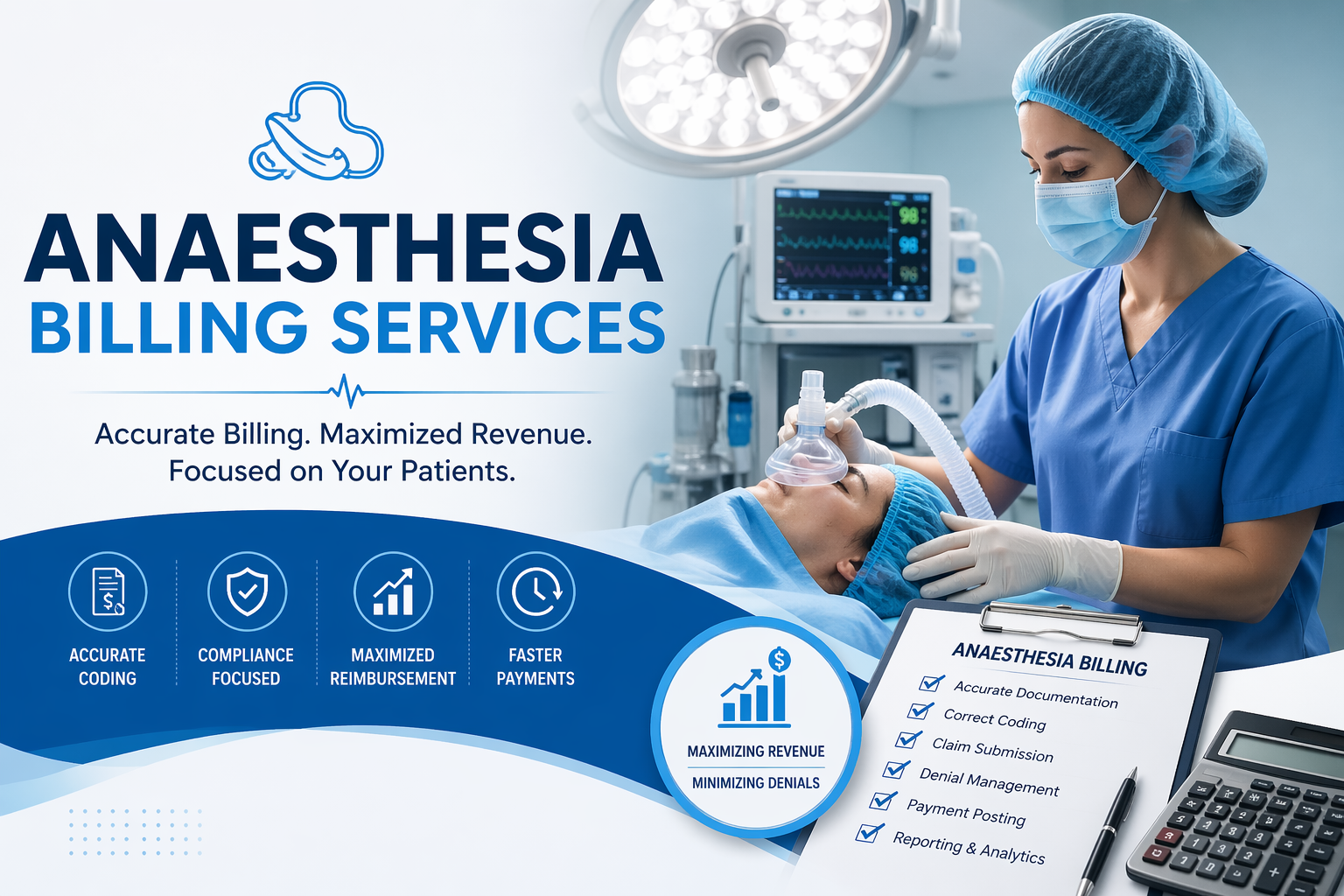
Anesthesia specialty billing is one of the most complex and financially sensitive areas in healthcare revenue cycle management. Unlike standard medical billing, anesthesia claims depend on time-based calculations, strict modifier usage, payer-specific rules, and detailed documentation of every minute of patient care. A small error in coding or timing can directly lead to underpayments or denials.
Industry data shows how significant the issue is. Studies indicate that anesthesia practices lose 8–15% of annual revenue due to billing inefficiencies and documentation gaps alone . In addition, first-pass denial rates for anesthesia claims can range between 12–18%, much higher than general physician claims . These numbers highlight why anesthesia specialty billing requires dedicated expertise rather than general billing workflows.
For hospitals, ASCs, and anesthesia groups, the financial impact is not just operational—it directly affects profitability, compliance, and long-term sustainability.
Billing Challenges in Anesthesia Specialty Billing
Anesthesia specialty billing is uniquely complex because reimbursement is not based on a single CPT code. Instead, it follows a multi-factor formula involving base units, time units, and modifiers. This structure creates multiple points of failure.
One of the biggest challenges is time-based billing accuracy. Anesthesia claims depend on precise start and stop times. Even minor inconsistencies between the anesthesia record and surgical documentation can trigger denials or reduced payments.
Another major issue is modifier complexity. Codes such as AA, QK, QX, QY, and QZ determine who performed the service and under what conditions. Incorrect modifier usage is one of the most common denial triggers in anesthesia claims .
Additional challenges include:
- Frequent payer rule variations across commercial and government insurers
- Medical direction documentation requirements (especially for CRNA cases)
- Lack of standardized anesthesia billing workflows across facilities
- Underpayment issues that often go unnoticed without audits
- High administrative burden on clinical teams
In many cases, these challenges are compounded by general billing teams who lack anesthesia-specific expertise. As a result, claims are often submitted with incomplete documentation or incorrect coding logic, increasing denial risk.
Choose the Right Billing Partner for Anesthesia Specialty Billing
Selecting the right billing partner can significantly improve revenue cycle performance and reduce claim leakage. A specialized partner in anesthesia specialty billing should offer more than basic claim submission—they should actively prevent revenue loss.
Key factors to consider include:
- Specialized anesthesia expertise (not general medical billing experience)
- Strong understanding of ASA guidelines and time-unit calculations
- Real-time claim scrubbing for modifier and coding accuracy
- Dedicated denial management and appeals team
- Compliance monitoring for payer-specific anesthesia rules
- Transparent reporting and performance analytics
- Experience handling CRNA, medical direction, and concurrent cases
A strong billing partner should function as an extension of your practice, not just a processing vendor. This is where experienced providers like 247 Medical Billing Services become critical for high-performing anesthesia groups.
Reduce Denials in Anesthesia Specialty Billing
Reducing denials in anesthesia specialty billing requires a proactive, structured approach. Most denials are preventable if the right systems are in place. Here’s how to improve clean claim rates:
1. Strengthen Time Documentation
Ensure anesthesia start and stop times are recorded in real time, not estimated later. Even small discrepancies can lead to underpayment or rejection.
2. Implement Pre-Submission Claim Scrubbing
Use automated and manual review processes to catch missing modifiers, incorrect units, or mismatched surgical codes before submission.
3. Standardize Modifier Usage
Train billing teams and providers on correct modifier application for CRNA and anesthesiologist roles. Modifier errors remain one of the top denial causes.
4. Conduct Regular Underpayment Audits
Not all revenue loss comes from denials. Many claims are underpaid without triggering alerts. Routine audits help recover hidden revenue.
5. Improve Documentation Alignment
Ensure anesthesia records, operative reports, and facility notes match perfectly to avoid payer disputes.
HIPAA Compliance and Technology in Anesthesia Specialty Billing
Modern anesthesia specialty billing depends heavily on secure digital systems and compliance-driven workflows. HIPAA regulations require strict protection of patient health information across billing platforms, data transfers, and storage systems.
Technology plays a key role in improving efficiency:
- Cloud-based billing systems ensure secure access and real-time updates
- Automated coding tools reduce human error in time-unit and modifier calculations
- AI-powered claim scrubbing identifies potential denial risks before submission
- Integrated EHR and billing systems improve documentation accuracy
Security is not optional. Any billing system handling anesthesia claims must meet HIPAA standards to avoid legal penalties and data breaches.
In addition, advanced analytics tools now allow practices to track denial trends, payer behavior, and revenue leakage patterns—helping improve long-term financial performance.
How 247 Medical Billing Services Helps with Anesthesia Specialty Billing
247 Medical Billing Services provides specialized support designed specifically for high-complexity specialties like anesthesia. Unlike generic billing companies, their approach is tailored to the unique demands of anesthesia specialty billing.
Their core value lies in combining domain expertise with technology-driven revenue cycle optimization.
Key advantages include:
- End-to-end anesthesia billing management from charge capture to payment posting
- Expert handling of anesthesia modifiers and time-unit calculations
- Dedicated denial prevention and appeals workflow
- Continuous monitoring of payer-specific anesthesia rules
- Detailed financial reporting and revenue tracking
- Compliance-focused HIPAA workflows to protect patient data
By reducing coding errors and improving claim accuracy, 247 Medical Billing Services helps anesthesia groups improve first-pass acceptance rates and reduce administrative burden on clinical teams.
Most importantly, they focus on preventing revenue leakage before it happens—not just recovering it after denial.
Conclusion
Anesthesia specialty billing is one of the most demanding areas of healthcare revenue management due to its dependency on time-based calculations, modifier precision, and strict payer rules. Even small errors can result in significant revenue loss, with industry studies showing up to 15% annual revenue leakage in anesthesia practices .
To stay financially stable, practices must move beyond generic billing systems and adopt specialized solutions that understand the complexity of anesthesia workflows.
Partnering with experts like 247 Medical Billing Services ensures cleaner claims, fewer denials, and stronger revenue performance through dedicated anesthesia billing expertise and compliance-driven processes.
Ultimately, success in anesthesia revenue cycle management depends on precision, specialization, and proactive denial prevention—three elements that define modern anesthesia specialty billing excellence.


 Deutsch

 English
 Arabic
 French
 Spanish
 Portuguese
 Turkish
 Dutch
Dutch
 Italiano
 Russian
 Romaian
 Portuguese (Brazil)
 Greek
Greek