


From 10 to 1,000 Courses: How LMS Platforms Can Scale With Authoring Software
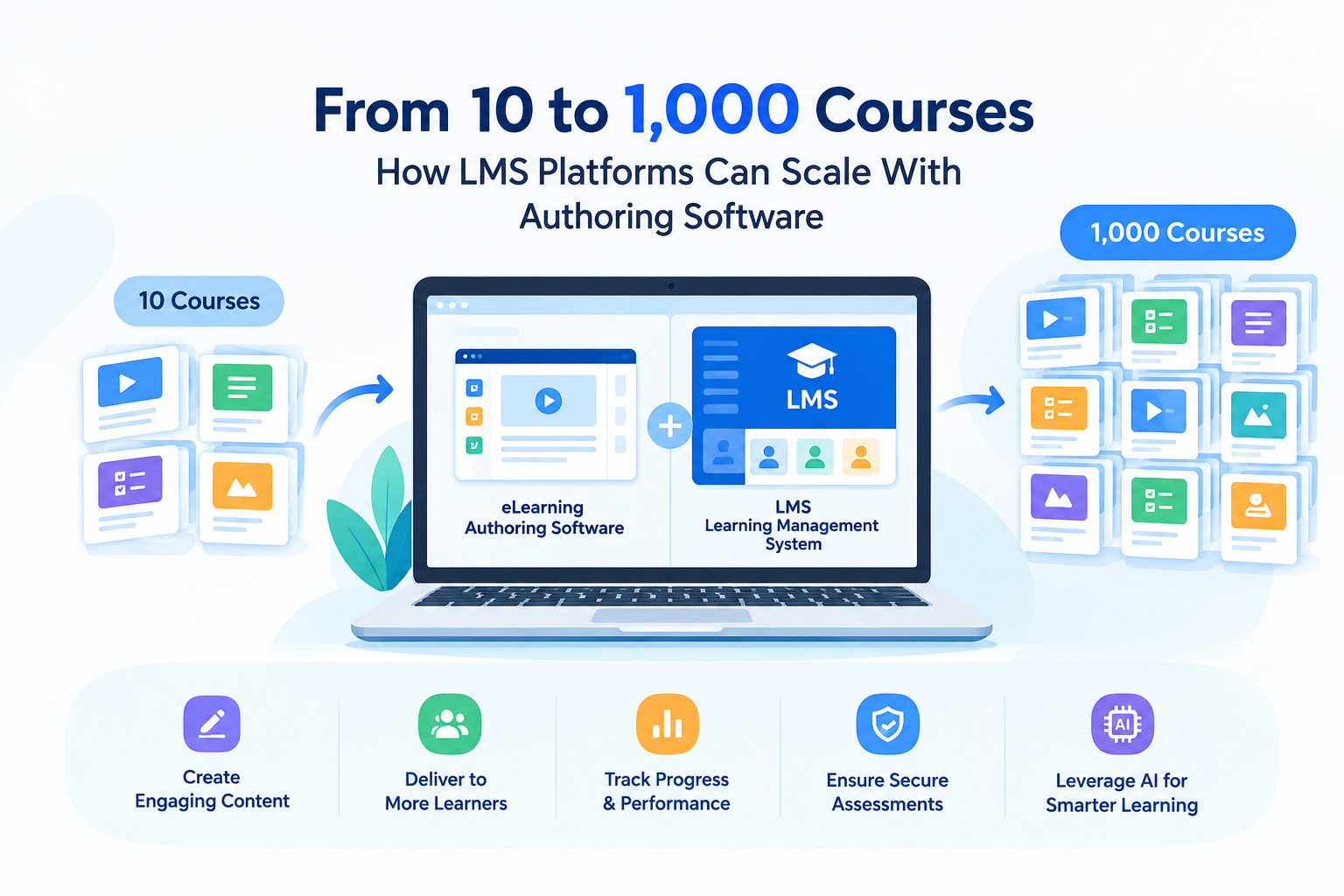
Launching an LMS is only the beginning. As organizations grow, their demand for high-quality training content grows with them. An LMS that once managed a few courses may eventually need to support hundreds or even thousands of learning programs across departments, locations, languages, and learner groups.
This is where eLearning Authoring Software becomes an important part of an LMS growth strategy. Instead of relying on slow, manual course-development processes, organizations can use modern authoring solutions to create, update, and publish engaging learning content at scale.
Why LMS Platforms Struggle to Scale Course Content?
A LMS Learning Management System is designed to organize and deliver learning. However, managing the learning environment is only one part of the equation. The LMS also needs a continuous supply of relevant and engaging courses.
As the number of learners increases, content teams often face challenges such as:
-
Longer course-development cycles
-
Limited instructional design resources
-
Repetitive content creation
-
Multiple languages and learner requirements
If course creation cannot keep pace with LMS growth, the platform may have thousands of users but not enough fresh content to keep them engaged.
How eLearning Authoring Software Supports LMS Growth?
Modern eLearning Authoring Software allows instructional designers, subject-matter experts, and training teams to build digital learning content without creating every element from scratch.
Templates, reusable components, quizzes, assessments, interactive activities, and multimedia features can accelerate production. Teams can also make changes to existing courses more efficiently instead of rebuilding an entire learning program.
Imagine starting with 10 courses. As customer demand increases, the organization may need 100, 500, or even 1,000 courses. A structured authoring workflow makes it easier to expand the library while maintaining consistency across the learning experience.
Building a Scalable LMS Learning System
A modern LMS Learning System should do more than simply store course files. It should support a complete learning ecosystem that brings together:
- Content Creation:
Develop engaging and relevant courses using eLearning authoring tools. - Content Delivery:
Deliver courses to learners based on their roles, skills, or learning requirements. - Assessment:
Create quizzes, tests, and other assessments to measure learner understanding. - Content Management:
Organize and update courses efficiently as training requirements change.
How Authoring Software Supports LMS Scalability?
Authoring software can serve as the content-production layer within an LMS ecosystem. It enables organizations to create reusable and standardized learning materials that can be delivered through the LMS.
For example, a training company can create:
- Employee onboarding modules
- Product training programs
- Leadership development courses
- Technical training programs
- Skills development courses
Once created, these courses can be organized and delivered through the LMS according to different learner groups and requirements.
Assessments and AI Online Exam Proctoring
Scaling an LMS also means scaling assessments. As course enrollment grows, organizations need reliable ways to evaluate learner knowledge and maintain assessment integrity.
This is where AI Online Exam Proctoring can complement an LMS. AI-powered proctoring solutions can assist with monitoring online examinations and identifying activity that may require review, depending on the system and its configuration.
For institutions, certification providers, and corporate training organizations, combining course authoring, LMS delivery, assessment, and online proctoring can create a more complete digital learning environment.
Instead of treating courses, exams, and learner records as separate processes, organizations can build a connected learning journey.
From Course Library to Content Engine
The biggest advantage of scalable authoring is not simply the ability to create a larger course library. It is the ability to establish a repeatable content engine.
An LMS provider can create templates for different course types, establish consistent branding, standardize assessment structures, and create reusable learning components. Subject-matter experts can contribute knowledge while learning designers focus on structure and learner experience.
As the LMS grows from 10 courses to 1,000, the organization does not need to reinvent its process for every new course. Instead, it can refine a framework that supports continuous content development.
The Future of Scalable LMS Content
The future of LMS growth will depend on more than adding servers or increasing user capacity. Content scalability will be equally important.
eLearning Authoring Software, an LMS Learning Management System, AI-powered learning capabilities, and AI Online Exam Proctoring can work together to create a more scalable digital education ecosystem.
For organizations planning long-term LMS growth, the key question is no longer simply, “How many courses do we have?”
A better question is:
“How efficiently can we create, deliver, assess, and improve the next 1,000 courses?”
Organizations that build scalable content workflows early can create a stronger foundation for expanding their LMS, supporting more learners, and adapting to changing training requirements.


 English
 Arabic
 French
 Spanish
 Portuguese
 Deutsch
 Dutch
 Italiano
 Russian
 Romaian
 Portuguese (Brazil)
 Greek
