


How to Build a Secure and Scalable Decentralized Exchange
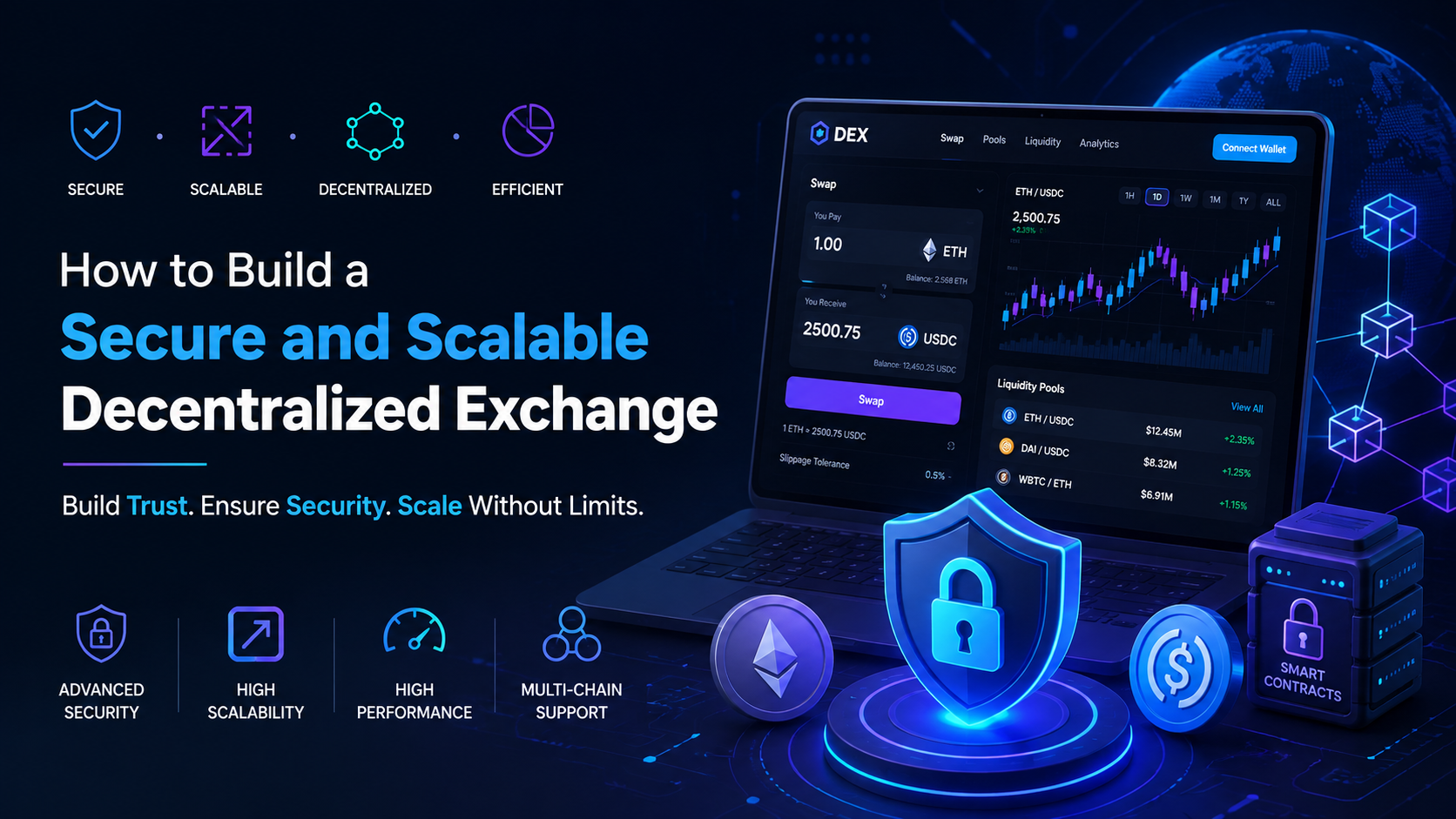
Decentralized exchanges (DEXs) are transforming cryptocurrency trading by allowing users to swap digital assets without relying on a centralized intermediary. Instead of handing control of funds to a third party, users connect their wallets and trade directly through smart contracts. However, building a DEX that is both secure and scalable requires careful planning across blockchain architecture, smart contracts, liquidity, user experience, and compliance.
For businesses exploring Decentralized Exchange development Services, understanding the development process, technology stack, security requirements, and potential DEX development Cost is essential before starting the project.
What Is a Decentralized Exchange?
A decentralized exchange is a blockchain-based trading platform that enables users to exchange tokens directly from their wallets. Unlike centralized exchanges, DEXs generally do not require users to deposit assets into a company-controlled wallet.
Popular DEX architectures use automated market makers (AMMs), order books, or hybrid models. AMMs rely on liquidity pools and mathematical formulas to determine token prices, while order-book DEXs match buy and sell orders.
A well-designed DEX should provide:
- Non-custodial trading
- Smart-contract-based transactions
- Wallet connectivity
- High liquidity
- Transparent pricing
- Low transaction latency
- Strong security controls
- Multi-chain or cross-chain capabilities where required
Step 1: Define the DEX Business Model
Before development begins, determine what type of exchange you want to build. Your business model will influence the blockchain architecture, smart contracts, liquidity strategy, and development budget.
Common DEX models include:
AMM DEX: Uses liquidity pools instead of traditional order books.
Order-Book DEX: Matches buyers and sellers using on-chain or off-chain order books.
Hybrid DEX: Combines order-book functionality with decentralized settlement.
You should also define supported trading pairs, transaction fees, liquidity incentives, governance mechanisms, supported wallets, and target users.
Step 2: Choose the Right Blockchain
Blockchain selection directly affects performance, transaction fees, scalability, and user experience.
Ethereum provides a mature smart-contract ecosystem and extensive developer tooling. Layer-2 networks can help reduce transaction costs and improve transaction throughput. Other ecosystems, such as Solana, Polygon, BNB Chain, and Avalanche, may be suitable depending on the project's performance and liquidity requirements.
When selecting a blockchain, evaluate:
- Transaction speed
- Gas or network fees
- Smart-contract capabilities
- Developer ecosystem
- Existing liquidity
- Wallet compatibility
- Security history
- Cross-chain support
For a scalable DEX, choosing infrastructure based solely on popularity can be a mistake. The blockchain should match the platform's expected trading volume and business requirements.
Step 3: Develop and Audit Smart Contracts
Smart contracts are the foundation of a DEX. They can control token swaps, liquidity pools, fees, staking, governance, and other core functions.
Security should be considered from the beginning rather than after development. Developers should follow secure coding practices and minimize unnecessary contract complexity.
Important security measures include:
- Reentrancy protection
- Access-control mechanisms
- Integer and arithmetic safety
- Slippage protection
- Oracle manipulation protection
- Flash-loan attack mitigation
- Emergency pause mechanisms
- Secure upgrade mechanisms
- Comprehensive unit and integration testing
Independent smart-contract audits should also be performed before the production launch. Multiple audits may be appropriate for high-value protocols or complex contracts.
Step 4: Build a Scalable Trading Engine
Scalability becomes critical as trading volume increases. A DEX must process transactions efficiently without creating excessive congestion or costs for users.
For AMM-based platforms, optimized liquidity-pool contracts and efficient routing can improve trading performance. For order-book systems, an off-chain matching engine combined with on-chain settlement can potentially provide faster execution while maintaining decentralized settlement.
Layer-2 solutions, optimized RPC infrastructure, transaction batching, caching, and efficient indexing can further improve platform performance.
Step 5: Integrate Wallets and Token Standards
A DEX needs seamless wallet connectivity because users generally interact with the platform through their own wallets.
Depending on the selected blockchain, integrations may include popular Web3 wallets and token standards such as ERC-20 or equivalent standards.
The interface should clearly display:
- Wallet balance
- Token prices
- Gas fees
- Slippage
- Minimum received amount
- Transaction status
- Network information
A simple and transparent trading interface can significantly improve user confidence.
Step 6: Implement Liquidity Management
Liquidity is one of the biggest challenges for a new DEX. Even technically advanced platforms can struggle if users cannot execute trades efficiently.
Liquidity can be encouraged through:
- Liquidity mining
- Staking rewards
- Trading incentives
- Liquidity-provider fees
- Partnerships with market makers
- Aggregation from multiple liquidity sources
The platform should also monitor liquidity depth, trading volume, price impact, and pool utilization.
Step 7: Add Security Monitoring
Security should continue after launch. A production DEX needs continuous monitoring for suspicious transactions, unusual liquidity movements, oracle anomalies, contract exploits, and abnormal trading behavior.
Useful measures include real-time transaction monitoring, automated alerts, bug bounty programs, incident-response procedures, and regular security reviews.
Multi-signature wallets can also be used for administrative operations where appropriate, reducing the risk associated with a single private key.
Step 8: Consider Cross-Chain Trading
As the blockchain ecosystem becomes increasingly fragmented, users may want to trade assets across multiple networks. Cross-chain functionality can expand the addressable market but also introduces additional technical and security risks.
Cross-chain bridges, messaging protocols, liquidity aggregators, or intent-based architectures can be considered depending on the project.
However, cross-chain functionality should be added only after carefully evaluating bridge security, liquidity fragmentation, transaction finality, and attack vectors.
Key Features of a Secure and Scalable DEX
A production-ready decentralized exchange may include:
- Wallet integration
- Token swapping
- Liquidity pools
- AMM or order-book functionality
- Staking and farming
- Limit and market orders
- Token listing
- Price charts
- Portfolio tracking
- Governance
- Multi-chain support
- Transaction history
- Analytics dashboard
- Admin and monitoring tools
- Security alerts
Not every DEX needs every feature. A focused MVP can launch with core trading and liquidity capabilities before advanced functionality is introduced.
DEX Development Cost
The DEX development Cost varies considerably depending on the project's complexity, blockchain ecosystem, security requirements, integrations, and development approach.
A basic DEX MVP with wallet integration, token swaps, liquidity pools, and essential smart contracts may require a substantially smaller investment than a multi-chain platform with advanced trading, governance, analytics, cross-chain functionality, and extensive security infrastructure.
Major cost factors include:
- Blockchain and architecture selection
- Smart-contract development
- Frontend and Web3 UX development
- Backend and indexing infrastructure
- Wallet and API integrations
- Security audits
- Liquidity and market-making infrastructure
- Cross-chain functionality
- Testing and deployment
- Ongoing maintenance and monitoring
Businesses should therefore estimate the budget after defining the required features and technical architecture rather than relying on a generic development-cost figure.
Final Thoughts
Building a secure and scalable DEX requires more than creating a token-swap interface. The platform must combine secure smart contracts, reliable blockchain infrastructure, efficient liquidity management, wallet integration, scalability strategies, and continuous monitoring.
Businesses evaluating Decentralized Exchange development Services should prioritize security and architecture from the earliest planning stage. Starting with a focused MVP, conducting professional smart-contract audits, and designing infrastructure for future growth can create a stronger foundation for long-term expansion.
Ultimately, the right technology stack and development strategy can help transform a DEX concept into a reliable Web3 trading platform while keeping performance, security, and DEX development Cost aligned with business objectives.
 Portuguese (Brazil)
 English
 Arabic
 French
 Spanish
 Portuguese
 Deutsch
 Turkish
 Dutch
Dutch
 Italiano
 Russian
 Romaian
 Greek
Greek
